



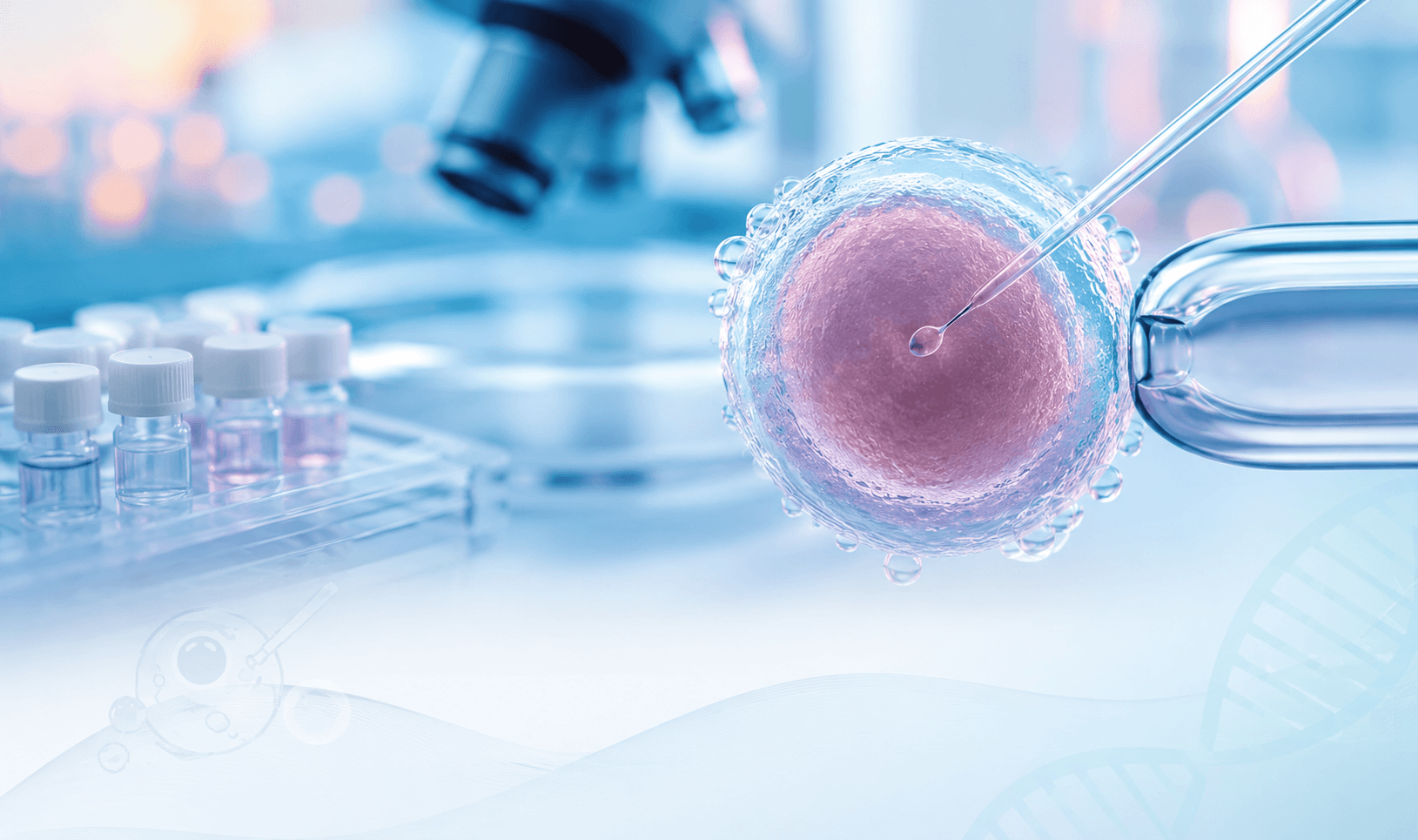
Microinjection (ICSI) in Cyprus
Microinjection, medically known as ICSI, is an advanced fertilization method in which a single sperm cell, selected by the embryologist, is injected directly into the mature egg. At Vita Altera IVF Center, ICSI treatment is personalized based on sperm characteristics, egg quantity and quality, previous fertilization results, and the couple’s medical history.
What Is Microinjection?
Microinjection is the process of injecting a single sperm cell directly into the cytoplasm of a mature egg using a specialized microscope and micromanipulation system. The international name for the procedure is intracytoplasmic sperm injection, abbreviated as ICSI.
ICSI is not a standalone fertility treatment but rather a laboratory fertilization technique used during the IVF process. The other stages—ovarian stimulation with medication, egg retrieval, embryo development monitoring, and embryo transfer—proceed similarly to conventional IVF.In the classic IVF method, prepared sperm cells are placed in the same laboratory dish with the eggs, and fertilization is expected to occur naturally when a sperm penetrates the egg on its own. In ICSI, the selected sperm cell is placed directly into the egg, bypassing the need to penetrate the egg’s outer layers.This method is particularly useful when sperm count is very low, sperm motility or morphology is severely impaired, or when sperm have difficulty reaching and fertilizing the egg.Microinjection Treatment in Cyprus
Microinjection treatment in Cyprus is a structured IVF process that includes comprehensive evaluation of both male and female reproductive health, ovarian preparation, egg retrieval, sperm selection, ICSI application, and embryo transfer.
At Vita Altera IVF Center, before treatment begins, the couple’s medical history, previous IVF attempts, sperm analyses, ovarian reserve, and prior fertilization outcomes are carefully reviewed.The decision to use microinjection is not based solely on a single sperm analysis. It is determined by evaluating the post-preparation sperm characteristics, the number of usable sperm, the maturity status of the eggs, and previous laboratory results.For patients traveling from Turkey or other countries, the initial consultation can be conducted online. Test and treatment reports can be reviewed before arriving in Cyprus, allowing us to prepare the necessary tests and a tentative treatment schedule.Online Pre-Evaluation
Sperm analyses, hormone results, ultrasound evaluations, and previous IVF reports can be reviewed before you arrive in Cyprus.Personalized Fertilization Plan
The choice between conventional IVF and ICSI is determined based on sperm and egg characteristics and previous fertilization outcomes.Embryology Monitoring
From fertilization check to embryo transfer, the entire laboratory process is managed by our experienced embryology team.Who Is Microinjection For?
ICSI treatment is primarily indicated for patients with sperm-related fertilization issues and in special cases where the likelihood of fertilization with conventional IVF is considered low.
- Men with severely low sperm count
- Men with significantly reduced sperm motility
- Men with pronounced sperm morphology defects
- Couples with no fertilization in a previous conventional IVF attempt
- Couples with very low fertilization rates in previous treatment cycles
- Patients where sperm are obtained surgically due to absence of sperm in the ejaculate
- Cases with limited usable sperm after thawing frozen samples
- Treatments using previously frozen eggs
- Appropriate cases requiring specific genetic testing programs
- Cases where embryology assessment indicates low sperm fertilizing capacity
Is Microinjection Applied to Every IVF Patient?
Although ICSI is a widely used laboratory technique, it is not routinely required for all IVF patients.
For patients without male factor infertility, with normal sperm values, and no history of fertilization failure, conventional IVF may be an appropriate option. Advanced maternal age, diminished ovarian reserve, or unexplained infertility alone do not necessarily mean that ICSI will always yield better results.When deciding on ICSI, the focus should be not only on fertilization rates but also on healthy embryo development, pregnancy, and live birth outcomes.What Is the Difference Between Conventional IVF and Microinjection?
The fundamental difference between IVF and ICSI lies in how the eggs are fertilized in the laboratory. The ovarian preparation, egg retrieval, embryo monitoring, and embryo transfer stages remain largely the same.
Conventional IVF
Prepared sperm cells are placed in the laboratory dish with mature eggs. One of the sperm cells is expected to penetrate the egg’s outer layers and achieve fertilization naturally.- Egg and sperm are brought together in the lab
- Sperm is expected to reach the egg on its own
- Requires sufficient quantity and quality of sperm
- Fertilization result is checked the next day
Microinjection – ICSI
A single sperm cell selected by the embryologist is injected directly into the mature egg using a micromanipulator and a very fine injection needle.- One sperm is selected for each mature egg
- Sperm is injected directly into the egg
- Overcomes sperm penetration issues
- Fertilization result is evaluated the next day
What Tests Are Performed Before Microinjection?
Since microinjection is part of an IVF treatment, both the female partner’s ovarian and uterine health and the male partner’s reproductive health are thoroughly evaluated.
Evaluations for the female partner
- Gynecological examination and ultrasound
- Ovarian reserve assessment
- AMH and relevant hormone tests
- Antral follicle count
- Evaluation of the uterus and endometrial lining
- Infectious disease screening
- Thyroid and blood sugar tests
- Hysterosalpingography or hysteroscopy when indicated
Evaluations for the male partner
- Semen analysis (spermiogram)
- Sperm count and concentration
- Sperm motility
- Sperm morphology
- Infectious disease screening
- Hormone tests when indicated
- Genetic evaluation when indicated
- Urology or andrology consultation
How Is Microinjection Performed?
Microinjection is not just the injection procedure in the laboratory. The treatment consists of a series of sequential stages, from ovarian preparation to the pregnancy test.
Initial consultation and treatment planning
The couple’s medical history, semen analyses, ovarian reserve, previous IVF and fertilization outcomes are evaluated to create a personalized treatment protocol.Controlled ovarian stimulation
Hormonal medications prescribed by the doctor are used to stimulate the development of multiple eggs in the female partner’s ovaries.Follicle development monitoring
The ovarian response to the medications is tracked with ultrasound and necessary blood tests. Medication dosages may be adjusted based on follicle development.Trigger shot
When follicles reach the appropriate size, a trigger injection is administered to support the final maturation of the eggs. The timing of the egg retrieval is planned according to this injection.Egg retrieval
Eggs are collected via a short procedure performed under ultrasound guidance. The retrieved eggs are evaluated for maturity in the embryology laboratory.Sperm sample collection and preparation
The sperm sample provided by the male partner undergoes specialized preparation in the laboratory. Motile and usable sperm cells are separated from the sample.Preparation of mature eggs
The cells surrounding the eggs are carefully removed. Only eggs that have reached the maturity stage suitable for microinjection are processed for ICSI.Selection of the appropriate sperm
The embryologist selects a sperm cell with favorable motility and structural characteristics based on laboratory assessment. The selection approach may vary depending on the sperm sample’s properties.Injection of sperm into the egg
The egg is secured with a specialized holding pipette. A single selected sperm cell is carefully placed into the egg’s cytoplasm using a very fine injection pipette.Fertilization check
The day after the injection, the eggs are examined for signs of fertilization. Eggs showing normal fertilization are placed into embryo culture.Embryo development monitoring
Cell division and embryo development are tracked by expert embryologists over several days. The transfer day is determined based on embryo development and the treatment plan.Embryo transfer and pregnancy test
The embryo with appropriate development is transferred to the female partner’s uterus. Post-transfer medication instructions and the pregnancy test date are provided to the patient.How Is Sperm Selected for Microinjection?
The selection of the sperm cell used in ICSI is one of the most critical steps in the embryology laboratory. The selection process is tailored to the characteristics of the sperm sample and the number of usable cells available.
Sperm motility
Motile sperm cells are evaluated for viability and usability.Sperm morphology
The structure of the sperm’s head, midpiece, and tail is examined under the microscope to assess for significant structural abnormalities.Sample preparation
Cellular debris and unsuitable cells in the sperm sample can be removed using specialized laboratory preparation techniques.Embryologist assessment
The final selection is made by the experienced embryologist based on the sperm cell’s motility and appearance under the microscope.Can Surgically Retrieved Sperm Be Used in ICSI?
In some patients with no sperm in the ejaculate or no usable sperm, surgical sperm retrieval from the testis or epididymis may be considered.
PESA
A method aimed at aspirating fluid containing sperm from the epididymis using a fine needle.MESA
A microscopic surgical procedure to retrieve sperm from the epididymal ducts.TESA or TESE
Methods that use needle aspiration or small tissue biopsies from the testis to search for sperm cells.Micro-TESE
A surgical technique using a microscope to search for areas of the testis with potential sperm production, particularly in patients with very limited sperm production.Whether surgical sperm retrieval is possible is determined based on the cause of infertility, hormone levels, genetic evaluations, and urology examination. Success in finding sperm cannot be guaranteed in advance.
How Long Does Microinjection Take?
The laboratory microinjection step is performed on the day of egg retrieval. However, since ICSI is part of the IVF treatment, the total treatment duration also includes ovarian preparation and embryo transfer stages.
Ovarian stimulation with medication typically lasts about one to two weeks. Following egg retrieval, microinjection is performed on mature eggs the same day.The fertilization check is generally done the day after the procedure. Embryos showing normal fertilization are monitored for development over several days, and the appropriate transfer day is determined.If the endometrial lining or hormone levels are not suitable for a fresh transfer, embryos may be frozen, and the embryo transfer can be planned for a subsequent menstrual cycle.Factors Affecting Microinjection Success
Even though the sperm is placed inside the egg during ICSI, the outcome of the treatment is not solely dependent on the injection technique. Egg, sperm, embryo, uterine, and laboratory factors must all be considered together.
Female partner’s age
Age is one of the most significant factors influencing egg quantity, egg quality, and chromosomal risks in embryos.Ovarian reserve
The ovaries’ response to stimulation and the number of eggs that can be retrieved can impact the treatment process.Egg maturity
Microinjection can only be performed on eggs that have reached the appropriate maturity stage.Egg quality
Even when sperm is injected, the egg’s cellular characteristics affect fertilization and embryo development.Sperm characteristics
Sperm motility, structure, viability, and genetic integrity can influence fertilization and embryo development.Fertilization outcome
Normal fertilization may not occur in every injected egg, and some cycles may result in no fertilization at all.Embryo development
Not all fertilized eggs will reach a developmental stage suitable for transfer.Uterine structure
A suitable uterine cavity and endometrial lining are important for implantation after embryo transfer.Laboratory expertise
The precise execution of microinjection, embryo culture conditions, and laboratory quality processes are all important.Risks and Limitations of Microinjection
Microinjection is performed by experienced embryologists using precise laboratory systems. However, like all medical and laboratory procedures, it carries certain risks and limitations.
Potential damage to the egg
There is a small but existing risk of damage to the egg cell during preparation or sperm injection.Failure of fertilization
Even though the sperm is injected into the egg, normal fertilization is not guaranteed.Embryo arrest
Even if fertilization occurs, embryo development may slow down or stop before reaching the transfer stage.Underlying genetic causes
Some types of severe male infertility may be associated with genetic factors. Genetic counseling and testing may be considered for appropriate patients.Microinjection Costs
Microinjection costs in Cyprus can vary depending on the scope of the IVF program that includes the ICSI procedure, medications, laboratory applications, and any additional required procedures.
Microinjection is typically part of a comprehensive treatment that includes ovarian stimulation, monitoring, egg retrieval, sperm preparation, laboratory procedures, embryo development, and embryo transfer.Key factors that may influence the total treatment cost include:- Initial consultation and necessary tests
- Medications for ovarian stimulation
- Egg retrieval procedure and anesthesia
- Sperm sample preparation
- Microinjection laboratory procedure
- Embryo culture and development monitoring
- Embryo transfer
- Need for embryo freezing and storage
- Surgical sperm retrieval procedure
- Need for genetic testing or counseling
- Additional sperm evaluation methods
- Accommodation and travel preferences
Why Choose Vita Altera IVF Center?
At Vita Altera, microinjection treatment is not viewed simply as injecting a sperm into an egg. The entire process, from the initial consultation to post-embryo transfer follow-up, is personalized for each patient.
- Personalized IVF and ICSI treatment planning
- Experienced gynecology and obstetrics specialists
- Experienced embryology and laboratory team
- Advanced micromanipulation systems
- Detailed sperm and egg evaluation
- AI-assisted sperm evaluation options
- EmbryoScope+ for embryo development monitoring
- Chip ID sample matching and security system
- ICSI capability with surgically retrieved sperm
- Embryo freezing and storage options
- Dedicated patient coordinator support
- Multilingual patient counseling
- Online pre-consultation availability
- Regular follow-up before and after treatment