


Required Tests Before IVF Treatment
The tests that may be requested before IVF treatment are determined based on your age, medical history, ovarian reserve, sperm evaluation, and previous treatments. Not every patient needs to undergo the same set of tests.

How Are the Required Tests Determined?
The test plan is not based on a standard list, but is prepared according to your individual medical findings and the planned treatment.
During the initial consultation, both male and female reproductive health are evaluated together. Age, menstrual regularity, pregnancy history, previous surgeries, medications used, prior treatment outcomes, and family history of hereditary diseases are taken into account.The timeliness and adequacy of any existing test results you have are reviewed. The aim is to avoid unnecessary repeat tests and to plan only the investigations that are truly needed.Key Areas Evaluated Before Treatment
The initial evaluation considers not just hormone results, but all fundamental factors that could affect reproductive health together.- 01
Medical History
Past illnesses, surgeries, medications used, chronic conditions, and allergies are evaluated. - 02
Pregnancy History
Previous pregnancies, births, miscarriages, ectopic pregnancies, and any issues during pregnancy are reviewed. - 03
Previous Treatments
Medications used in previous IUI or IVF cycles, egg counts, and embryo outcomes are assessed. - 04
Female Reproductive Health
Menstrual regularity, ovarian reserve, uterine structure, ovaries, and fallopian tubes (if needed) are evaluated. - 05
Male Reproductive Health
Sperm count, motility, morphology, and factors affecting male reproductive health are examined.
Tests That May Be Requested for Women
The tests that may be requested can vary based on age, menstrual regularity, ovarian reserve, pregnancy history, and the planned treatment method.AMH Test
One of the blood tests that helps assess ovarian reserve.FSH and Estradiol
Can be used, often in the early days of the menstrual cycle, to evaluate ovarian function.LH Test
Can help assess ovulation patterns and hormonal balance.Progesterone
Can be used in indicated patients to assess whether ovulation has occurred.Thyroid Tests
Thyroid function can be evaluated based on the patient’s history and clinical findings.Prolactin
May be requested in cases of menstrual irregularity, milk discharge (galactorrhea), or clinical suspicion.Ultrasound
The uterus, ovaries, and antral follicle count can be assessed via ultrasound.General Health Tests
Complete blood count, blood type, and other basic tests can be planned according to general health status.How Are the Uterus and Tubes Evaluated?
Evaluations of the uterine cavity and fallopian tubes are not performed routinely on every patient in the same way.
Ultrasound evaluation can examine the uterine structure, endometrial lining, ovaries, and findings related to cysts, fibroids, or polyps.If assessment of tubal patency is needed, your doctor may recommend an X-ray hysterosalpingography (HSG) or ultrasound-based imaging methods.- Transvaginal ultrasound assessment
- HSG (Hysterosalpingography / X-ray uterine film)
- Ultrasound assessment of tubal patency (HyCoSy)
- Saline infusion sonography (SIS) if needed
- Hysteroscopy if clinically indicated
Not every patient needs an HSG
The method used is determined by the doctor based on pregnancy history, ultrasound findings, previous surgeries, and the planned treatment.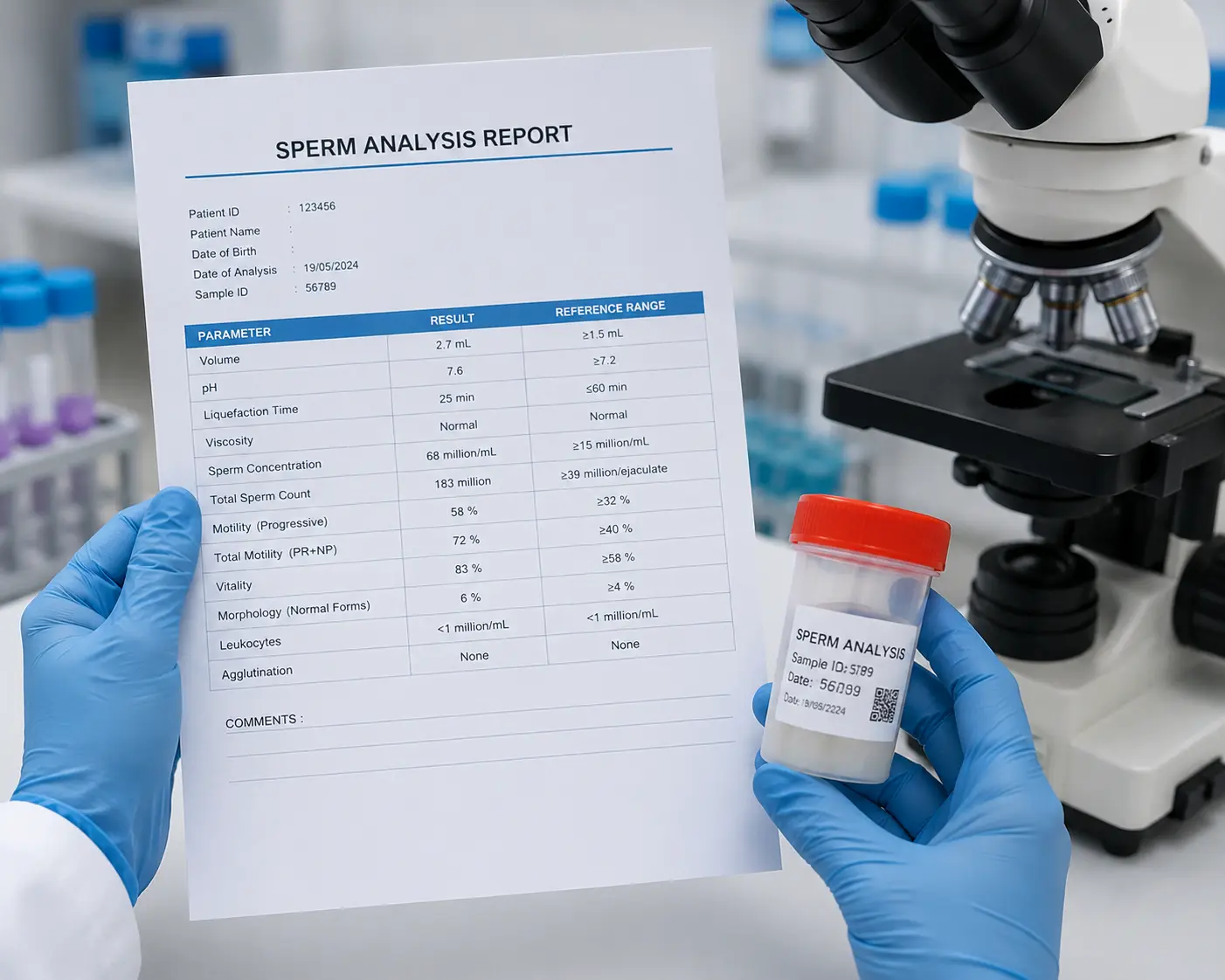

Tests That May Be Requested for Men
One of the primary and fundamental assessments of male reproductive health is the semen analysis.
Semen analysis evaluates sperm count, concentration, motility, and morphological characteristics. A single test result may not always be sufficient for a definitive assessment.If the result is outside the normal range, if no sperm are seen, or if there are additional findings related to male reproductive health, further evaluations may be planned.Infection and General Health Tests
For treatment and laboratory safety, certain infection screenings and general health tests may be requested from both partners.The accepted validity period for infection tests may vary depending on the planned procedure and the laboratory protocols of the center. When the tests should be performed will be communicated by your patient coordinator.
Who May Be Recommended Genetic and Advanced Tests?
Genetic and advanced laboratory tests are not routine for every couple. They may be recommended by the doctor based on personal and family health history.Suspected Hereditary Disease
If there is a known genetic disease or carrier status in the family, genetic counseling and appropriate tests can be planned.Recurrent Pregnancy Loss
Based on the history of pregnancy loss, uterine, genetic, hormonal, or other medical evaluations may be performed.Advanced Male Evaluation
If sperm count is very low or no sperm is found, hormonal and genetic tests may be requested.Not every advanced test is necessary for everyone
Immunological tests, coagulation tests, sperm DNA assessments, endometrial tests, or comprehensive genetic investigations should only be planned based on individual medical necessity.On Which Day of the Menstrual Cycle Are Tests Performed?
The timing for each test is not the same. Some tests are performed on specific days of the menstrual cycle, while others can be done at different times.AMH
Can be assessed on different days of the menstrual cycle in most cases.FSH and Estradiol
Usually assessed in the early days of the menstrual period.Progesterone
Planned according to cycle timing to evaluate ovulation.Ultrasound
Can be performed on different days of the menstrual cycle depending on the finding being evaluated.Uterine and Tubal Tests
The appropriate day is determined considering menstrual bleeding and the possibility of pregnancy.Semen Analysis
Preparation and sexual abstinence rules specified by the laboratory must be followed.Infection Tests
Planned considering the treatment start date and the validity period of the tests.Genetic Tests
Performed at the appropriate time after genetic counseling and doctor’s assessment.You Can Share Your Existing Tests With Us
Before re-doing tests you have already taken, you can send your existing results for a doctor’s review.
Hormone tests, ultrasound reports, semen analyses, HSG results, surgical reports, and embryology records from previous IVF treatments can be reviewed.After evaluating whether the results are current and which tests need to be repeated, a personalized test list will be created for you.- The date the test was performed must be visible
- Laboratory reference ranges should be included in the file
- Imaging reports should be sent completely
- Previous embryology reports should be shared
- The names of medications used should be specified